If you’re looking to improve the first few chapters of your novel, here are three impactful ways that I’ve found make my introductions much more compelling.
Happy writing! 🙂

Terry Ibele: Toronto Stop Motion Animator
If you’re looking to improve the first few chapters of your novel, here are three impactful ways that I’ve found make my introductions much more compelling.
Happy writing! 🙂
“I want to write a novel, but I just don’t have the time.”
That’s what I hear from people after they find out I wrote my first novel.
Novels don’t just happen. They take a lot of persistence and super hard work:
But I know that every time I spend even just 1 hour writing, I’m doing what 100 others aren’t. And that’s putting me ahead of the game, little by little.
If you’re thinking of writing a novel, I encourage you to sit down, open a word document, and just start typing 🙂
 (here’s the link to last month’s watercolor newsletter)
Here’s the link to my Facebook Page. I also post the videos on my blog here.
Here’s the link to The Simple Test That Will Tell You How Compelling Your First Chapter Is
That’s all this month. Happy Fall!
From Terry!
 If you think the first chapter of your novel could use some improvement, there’s one simple test that can tell you how to make it better.
Kill the main character at the end of your first chapter.
This will tell you how compelling your first chapter is.
Write something like, “Jim slips off the bridge and falls to his death.”
Now your main character is finished. He can’t achieve any of his goals.
Next, list out all the consequences that come into effect since the main character can’t achieve their goals.
If the list is short and lacklustre, it’s a good sign that your first chapter has room for improvement.
The consequences matters because they give the reader an idea of what’s at stake. The larger the stake, the more compelled your reader will be to find out what happens next.
A great example is Katniss Everdeen from Suzanne Collins’ The Hunger Games.
Let’s kill her at the start of the novel and see what happens.
“The train to District 1 crashes and Katniss Everdeen dies.”
Now what consequences come into play if Katniss can’t accomplish her main goal?
Main Goal:
Consequences:
The consequences of Katniss’ death are very high and the reader doesn’t want any of those things to happen. The reader eagerly turns each page to find out what happens next, because Katniss must accomplish her goal above all cost.
A great thing about this test is that you can keep killing your main character at the end of each chapter to see if the consequences are still high enough to keep the reader engaged.
As in The Hunger Games, each chapter proves to test Katniss’ ability to survive and raises the consequences even higher:
A lot of emerging authors don’t realize that the consequences must be clear from the start. It’s why most first-time novels don’t make it. It’s why mine didn’t.
When I finished my first novel, The Moon King, I used the first few chapters to introduce the setting, characters, and the main character’s goal, but I didn’t spell out the consequences until later chapters.
The initial feedback I got was very telling. It was to the effect of, “The first half is boring and drudges along, but the second half is super exciting and I couldn’t stop reading.”
Now that I’ve learned about building up consequences right away using the “Kill the main character” test, I’m editing my first few chapters to be much more compelling.
If you think that your first chapter could use some improvement, simply kill the main character and list out the consequences that you’ve written about so far.
If there aren’t many, or they aren’t very high, then you may need to do a rewrite.
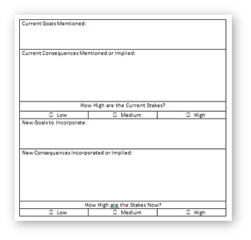
Here’s a simple template you can use to do the test on your chapters (it’s a downloadable word doc)
Happy writing!
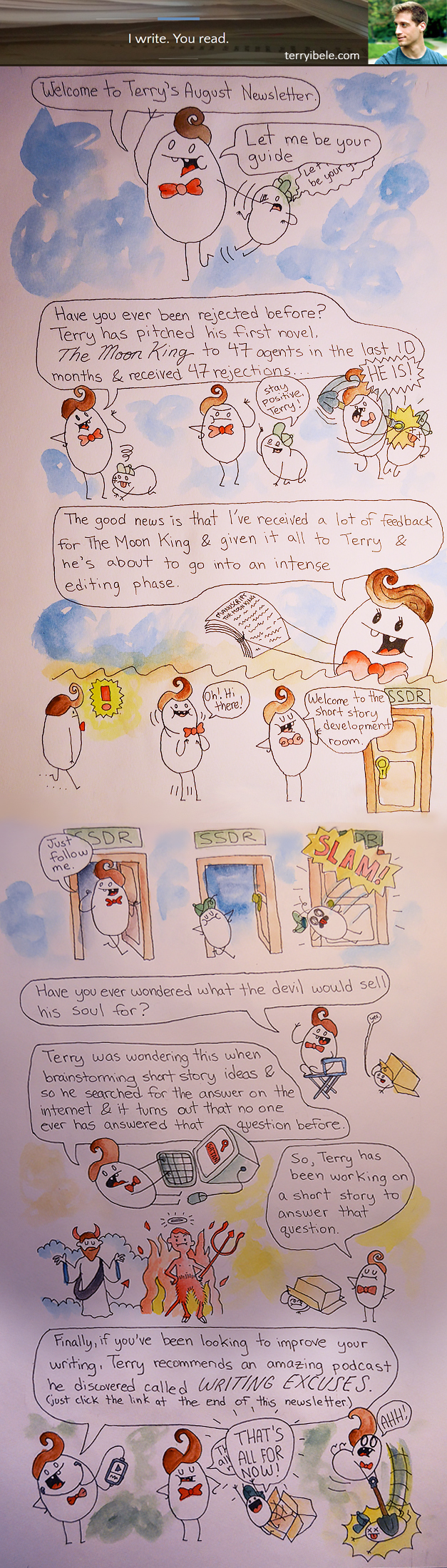
Here’s another watercolour newsletter this month!
(here’s the link to last month’s newsletter)
Here’s the link to the Writing Excuses podcast.
That’s all this month. Enjoy the rest of the summer.
From Terry!
 I just came across a podcast that has helped me figure out my next step as an aspiring writer.
I finished my first novel last October and have stopped querying agents after I got rejections from 47.
I know there were a number of glaring flaws in my novel, but I was faced with the question:
Do I write something new? Or do I revise my last novel?
I thought the answer was the latter, so I started my second novel only to realize 6 chapters in that I still have no idea what I’m doing. Overwhelmed by all the mediocre advice from other “authors” on the internet, I began searching for some more legitimate advice and stumbled upon a fantastic podcast called, Writing Excuses.

“Writing Excuses is a fast-paced, educational podcast for writers, by writers. It airs weekly, with new episodes appearing each Sunday evening at around 6pm Eastern Time. The show is hosted by Brandon Sanderson, Mary Robinette Kowal, Howard Tayler, and Dan Wells, with guests featured from time to time.
Our goal is to help our listeners become better writers. Whether they write for fun or for profit, whether they’re new to the domain or old hands, we have something to offer. We love to write, and our listeners do, too.”
I downloaded Season 1 of the podcast and went for a jog.
I just got home (sweaty and exhausted), and holy guacamole I’m hooked! I ended up listening to 4 episodes in a row, because they’re like crack!
The podcast is hosted by Brandon, Mary, Howard, and Taylor, all seasoned writers themselves. The episodes are 15 minutes and tips they gave are so fresh, sensible, and strategic that I just couldn’t help clicking “next podcast”.
The hosts are super down-to-earth, funny, and most importantly completely relatable. Instead of just telling me what to do, they talk about their struggles and how they overcame them. I found myself nodding, “Yes. Yes, this is exactly me!”
Following the story of Dan, from from Episode 17: This Sucks and I’m a Horrible Writer, I now know what to do to become a better writer so early in my career. Dan tells about how he wrote 13 novels before getting published the first time. He attributes his success to finally revising his previous novels and analysing where he could improve. Then, voila! His next novel was a success, because he knew exactly where to start.
If you’ve been searching for a podcast that will help inspire you to become a better writer, you may also find this podcast very enjoyable. So far, I’ve found this to be the best podcast for writers.
Give it a listen here (it’s hilarious).
For me, I’m going to go back and start analysing my first novel.
Here are some other wonderful writing podcasts suggested to me after I wrote this post:
Happy Writing!
Heyo my fellow writers!
If you’re like me, you’re reflecting on everything you’ve done this past year.
For me, I think this is my biggest year of accomplishment yet. I hope it sets a precedent for a super successful 2016!
This past year, I discovered what I really want to do with myself. For years I’ve dabbled in many different arts. Here are just a few of my hobbies over the past few years:
But, after all these activities, meeting new people, learning new skills, and trying different things, only one thing has stuck with me: writing.
Writing! I didn’t think I’d ever be a writer, especially after spending years perfecting my craft with Stop Motion Animation. But writing it is.
After writing crept up to my window at night, snuck through the crack and slipped into my head unnoticed, I’ve taken it up as more than a passion.
And this is the year that I really kicked off my writing career. Here just some of my accomplishments (even meagre as they seem, they’re baby steps to something greater!)
My gosh, I’m certain there’s even more. But what I’ve learned is that you don’t get anywhere without hard work and persistence. I hope I can keep up in 2016!
Let me know what accomplishments you’ve made this past year too!
Happy Writing!
Octotea
You’ve just finished your first novel. Your next step is getting published, right?
Wrong! There’s so many other steps you need to do after finishing your novel. What about finding an editor? What about agents? What about self-publishing?
All these questions were going through my mind earlier this year.
I spent months and months trying to figure out what to do with my first completed novel. Writing it was one thing. I hardly believed I would ever even finish it, that I never even thought about getting it published.
What I needed was a guide to help me understand everything I had to do.
Unfortunately I couldn’t find one on the internet. Believe me, I did plenty of research… this past year, I…
What I wish I would have found (which I didn’t), was an ALL-IN-ONE guide on everything I needed to do to go from the finished-my-first-novel phase to getting-my-first-agent phase.
I spent months learning exactly what to do, what would work, what wouldn’t work, and I’m proud to say that I’m currently in the query phase. And while I don’t have an agent yet, I have had a few that have been interested in my novel.
So, in the mean time, I’ve put together a complete guide on everything I’ve learned to get myself to this point.
So, if you’ve just finished your first novel, this guide is perfect for you! I’ve been in your shoes. I know the confusion, the hesitation, the plain not-knowing-what-to-do. BUT! Now I’m miles ahead.
This guide will put you miles ahead too.
So, what are you waiting for? Take a look at my Ultimate Guide on how to Publish Your First Novel.
 You need to know how to write a killer query letter!
If you’re like me, you write a lot of short stories – like at least one a week!
I’ve been fortunate enough to be involved in a writing group that helps me critique my work. This not only means that I receive lots of tips on my writing, it also means that I’m constantly reading drafts of other people’s short stories ALL THE TIME!
And I’ve learned a few things. Actually, I’ve learned a lot!
And perhaps one of the most important things I’ve learned is how well the intro to your short story has to be (we’re talking the first 1 or 2 paragraphs).
Think of the intro to your short story as the first bite of a new food. You’re curious. You’re sceptical. You’re ready to spit out your first bite and throw the entire dish away if you don’t like it. BUT! If that first bite tastes delicious, you’ll gobble everything else up as fast as you can.
That’s what the intro to your story is.
If it’s got a fantastic hook and glimpses of something great, your reader will keep reading at breakneck speed.
If it’s just “meh,” you’ve already lost your reader. With millions of other things to read on the internet, or in stores, why would anyone ever keep reading “meh”?
So, how do you make your intro super great? Well, to be honest, I’m still learning. But, I’ve also learned a heck of a lot so far, and my introductions are getting better. I’m writing better hooks. I’m retaining readers for longer. I can see a clear distinction between what I wrote even a month ago and what I’m writing now.
Every time I write an introduction, I use a checklist. While some of the items may seem a bit obvious, it’s amazing how many times I get too excited about one aspect of what I’m writing and forget to include them.
Checklist for How to Write a Short Story:
Now, this list isn’t the be-all and end-all of short story introductions, but it is a good start to keep you on track.
So, what are you waiting for? Take a short story you’ve written and compare the introduction to this checklist and see what matches up.
Happy Writing!
You need to know how to write a killer query letter!
You’ve finished your first novel, but you don’t know what to do next.
I’ve been in your shoes. The above statement described me perfectly after I’d finished writing my first novel.
I spent months of research, reading blogs, consulting with authors, following & writing agents, and talking with other people who were on the same journey as me.
This free guide is everything I’ve learned about the whole after-finishing-my-novel-and-now-I-want-to-get-published process.
It’s your cheat sheet to skip trying to figure what to do on your own.
So, check out this free, ultimate guide on How to Publish Your First Novel and learn everything about how to get your first agent that will push you full steam ahead into a bestseller!
The Ultimate Guide on How to Publish Your First Novel
You need to know how to write a killer query letter!


 Terry Ibele: Toronto Stop Motion Animator