This 15 Minute Writing Podcast is like Crack for Aspiring Authors.

crack-podcastI just came across a podcast that has helped me figure out my next step as an aspiring writer.

I finished my first novel last October and have stopped querying agents after I got rejections from 47.

I know there were a number of glaring flaws in my novel, but I was faced with the question:

Do I write something new? Or do I revise my last novel?

I thought the answer was the latter, so I started my second novel only to realize 6 chapters in that I still have no idea what I’m doing. Overwhelmed by all the mediocre advice from other “authors” on the internet, I began searching for some more legitimate advice and stumbled upon a fantastic podcast called, Writing Excuses.

Untitled.png

“Writing Excuses is a fast-paced, educational podcast for writers, by writers. It airs weekly, with new episodes appearing each Sunday evening at around 6pm Eastern Time. The show is hosted by Brandon Sanderson, Mary Robinette Kowal, Howard Tayler, and Dan Wells, with guests featured from time to time.

Our goal is to help our listeners become better writers. Whether they write for fun or for profit, whether they’re new to the domain or old hands, we have something to offer. We love to write, and our listeners do, too.”

I downloaded Season 1 of the podcast and went for a jog.

I just got home (sweaty and exhausted), and holy guacamole I’m hooked! I ended up listening to 4 episodes in a row, because they’re like crack!

The podcast is hosted by Brandon, Mary, Howard, and Taylor, all seasoned writers themselves. The episodes are 15 minutes and tips they gave are so fresh, sensible, and strategic that I just couldn’t help clicking “next podcast”.

The hosts are super down-to-earth, funny, and most importantly completely relatable. Instead of just telling me what to do, they talk about their struggles and how they overcame them. I found myself nodding, “Yes. Yes, this is exactly me!”

Following the story of Dan, from from Episode 17: This Sucks and I’m a Horrible Writer, I now know what to do to become a better writer so early in my career. Dan tells about how he wrote 13 novels before getting published the first time. He attributes his success to finally revising his previous novels and analysing where he could improve. Then, voila! His next novel was a success, because he knew exactly where to start.

If you’ve been searching for a podcast that will help inspire you to become a better writer, you may also find this podcast very enjoyable. So far, I’ve found this to be the best podcast for writers.

Give it a listen here (it’s hilarious).

For me, I’m going to go back and start analysing my first novel.

BONUS

Here are some other wonderful writing podcasts suggested to me after I wrote this post:

Happy Writing!


Subscribe to my emails (I promise I won’t use your email to respond to any Nigerian Princes)

Go back

Your message has been sent

Warning
Warning

Warning.

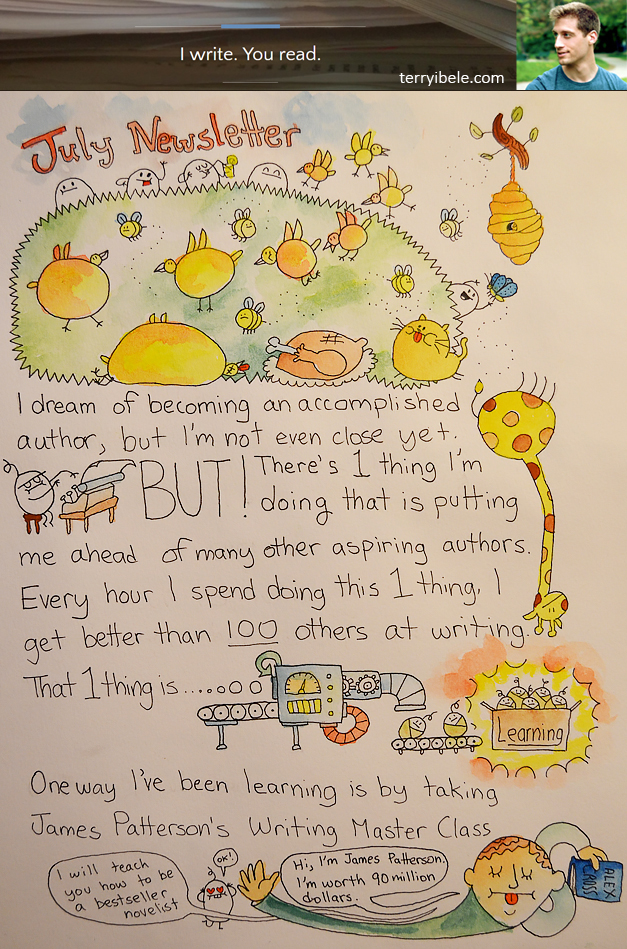
Terry’s July Newsletter

This month I painted my email newsletter with watercolours!

July1

Click here to check out James Patterson’s Writing Master Class

July2
Click here to ready my story in Fiction Magazine’s New Realm Volume

July3.jpg
Click here to read my 13 sure-fire ways to avoid bees

July5


Subscribe to my emails (I promise I won’t use your email to create an ad on Craigslist)

Go back

Your message has been sent

Warning
Warning

Warning.

7 Dumb Things Fantasy Novels Should Stop Doing

1. The Name You Can’t Pronounce

No, this isn’t he who shall not be named. This is that name you have no friggen clue how to say. It’s got twelve hyphens and six apostrophes with no vowels and two Q’s at the end.

It’s names like, M’Tsluiqrth-Neiea, Xaro Xhoan Daxos, Bene Tleilax, or Hermione (even JK Rowling had to give us clues how to pronounce that).

Why make it hard for us readers? When I come across someone’s unpronounceable name, I just make up my own name instead. Bene Tleilax (from Frank Herbert’s Dune) just becomes, “Bean Tax” every time I read it, which makes the name even more ridiculous than it was before!

If I could slap every author who uses an unpronounceable name, I’d have a very sore hand.

2. The Blonde-Eyed, Blue-Haired, Chiseled Body, 16-Year Old Main Character

This applies mostly to Young Adult, but unless your story is about an Adonis statue that has come to life, why is your main character the epitome of teenage perfection?

Did every fantasy writer miss the awkward years of pimple covered faces, squeaky voices, mysterious hair, and clumsy growth spurts?

3. The Ultimate Supreme Leader of the World Meets with Some Dumb Kid to Determine the Fate of Society

I’m looking at you, Hunger Games, Divergent, Harry Potter, and every other Young Adult Dystopian Fantasy.

If real life has taught us anything, it’s that teenagers always know what’s right and are the true heroes of society. They just aren’t old enough to drink… or smoke… or drive… or vote… or have a job… or literally do anything but go to school. But that’s okay. That one awkward and quiet teen who sits in the back, who’s never had to balance a cheque book, or do income taxes, or even grocery shop, she’s the one who truly knows what’s right. Why? Well… because… of her heart or something about her staying true to herself… and every person in the country will look to her as a symbol of hope and freedom.

I imagine this is how the liberation of North Korea will come about.

4. Every Character Ever is White

In Fantasy Land, only white people exist. What’s even stranger is that other species are also portrayed white. Elves? White. Dwarves? White. Fairies? White. Hobbits? White. Alien races? White.

You’d think that with a genre where literally anything can happen, there would be more diversity. Wizards, Knights, Princesses, Villagers, Witches… Everyone is white!

5. Time Warp Travel

Okay, so I get that it would be boring to read about a group of people walking for three weeks (with the exception of Tolkien, *wink*). But, everything in Fantasy Land seems to happen so damn fast!

I did my research. A horse can only travel 30 miles/day, which means that a lot of fantasy novels are going to need a reality check.

6. Wounds Heal Instantly

Last time I stubbed my toe, I took a week off work, but that character who just got a sword to the shoulder? He said “ouch” when it happened, and it’s all good now.

There’s also zero risk of infection, and broken bones are somehow still usable. How is nobody calling these instances out?

“Wait a minute… didn’t that character just break his leg and now he’s walking again?”

Shhhhh… Shhhh… It’s okay. Just let the chloroform make you sleep.

7. Super Duper Flowery Descriptions

The elegance of the indigo twilight settled calmly across the still, baby bird blue, watery lake as a gentle breeze brought fine scents of freshly cut spring daffodils to her soft, pale, perfectly round nostrils.

Some fantasy novels need to come with a knife so the reader can put themselves out of their misery.

Okay, okay. I get it.

The genre is called “Fantasy” for a reason, which means anything can or cannot happen with or without rules, so I shouldn’t complain. Gosh!

Want updates? Subscribe below! (I promise I won’t sell your email on the black market)

Go back

Your message has been sent

Warning
Warning

Warning.

P.S. The Moon King

I’ve written my own fantasy novel and I’m definitely guilty of a lot of these terribly annoying clichés.

Since you’re reading this, why not read my novel, The Moon King? You can read the first it here. You can take a big red marker and highlight every cliché I made and send it back to me so I can feel bad, like I should.

4 Free Tools to Help You Find the Perfect Agent

Heyo! If you’re looking to get your work published, you already know that you have to go through an agent first.

Here are 4 free tools that will help you to find your perfect agent!

1) Agentquery.com

This is what you want to use to find an agent.

Not sure how to find an agent? Start with agentquery.com. Simply choose which type of genre your manuscript falls under and agentquery.com will instantly pull a list of hundreds of agents looking for your type of manuscript.

It’s super simple to scroll through agents at a glance, or read more about each agent in their profile. Perhaps the most helpful thing is that agentquery.com lists each agents’ requirements and links directly to their website.

2) Querytracker.net

This is what you want to use to keep track of which agents you’ve contacted.

This website is awesome. It has pretty much every agent you could hope to find on the internet. What’s also even more awesome about it is that it allows you to track who you’ve queried, and what their response was.

Before I stumbled across querytracker.net, I was keeping track of all my query letters in excel. I had columns for agents’ names, emails, requirements, what I’d sent them, and their response. Querytracker.net does this all for you in an even more simple way.

3) Twitter #10queries

This will let you see agents critique query letters.

#10queries is a great # to follow on twitter, because agents use it to critique their slush piles of query letters. They’ll usually write a few words about what the query is pitching and tell you what they like and don’t like.

I use it to see what types of things agents are looking for and also what to avoid.

4) Twitter Pitch Parties

This is what you use to get in touch with agents as fast as possible.

During a pitch party, you tweet a one-sentence synopsis of your novel and include a certain #. During the pitch party (often just one day), hundreds of agents will peruse the tweets associated with the # and favourite the pitches that they like. If they favourite yours, it means they want you to email them directly with your full query.

This is the fastest way you can get in touch with agents, without waiting for them to go through their slush piles.

Carissa Taylor keeps an ongoing calendar of upcoming pitch parties on her blog. I suggest scrolling through her list and seeing if there are any coming up that you can participate in.

Happy Writing!

Finished your first manuscript?

killer queryYou need to know how to write a killer query letter!

  • Learn the 3 step process
  • Know how to format your query in a professional manner
  • Read examples of other killer queries
  • Plus tips & tricks to get ahead & more! 

    Go back

    Your message has been sent

    Warning
    Warning

    Warning.


2015 is OVER!

Heyo my fellow writers!

If you’re like me, you’re reflecting on everything you’ve done this past year.

For me, I think this is my biggest year of accomplishment yet. I hope it sets a precedent for a super successful 2016!

This past year, I discovered what I really want to do with myself. For years I’ve dabbled in many different arts. Here are just a few of my hobbies over the past few years:

  • Kick boxing, soccer, softball, archery (got pretty good at getting a bull’s eye!)
  • Painting giant murals, sculpting horses, high-fashion photography with amateur models from Model Mayhem
  • I produced three Short films, and created over 50 stop motion animation
  • Plus, I took up calligraphy and I’m half way through a writing a Tome of Wizard Spells

But, after all these activities, meeting new people, learning new skills, and trying different things, only one thing has stuck with me: writing.

Writing! I didn’t think I’d ever be a writer, especially after spending years perfecting my craft with Stop Motion Animation. But writing it is.

After writing crept up to my window at night, snuck through the crack and slipped into my head unnoticed, I’ve taken it up as more than a passion.

And this is the year that I really kicked off my writing career. Here just some of my accomplishments (even meagre as they seem, they’re baby steps to something greater!)

  • I finally took the novel I’d be casually working on over the past 10 years more seriously and finished it
  • I wrote nearly 50 short stories and flash fiction pieces and sold 4 of them (not to mention that I’ve been rejected dozens of times!)
  • I self-published my own book, got it to the top seller in its category while it was free, and then sold nearly a dozen copies
  • I started a patreon and have $23 of support for each of my flash fiction pieces I post
  • I created my first course on how to get an agent
  • I got over 300 followers on my Twitter account
  • I joined a writing group that meets every two weeks to critique each other’s work
  • I also started this blog!
  • And last, but not least, I’ve improved my writing GREATLY

My gosh, I’m certain there’s even more. But what I’ve learned is that you don’t get anywhere without hard work and persistence. I hope I can keep up in 2016!

Let me know what accomplishments you’ve made this past year too!

Happy Writing!

Octotea


A Shortcut to Getting Published

You’ve just finished your first novel. Your next step is getting published, right?

Wrong! There’s so many other steps you need to do after finishing your novel. What about finding an editor? What about agents? What about self-publishing?

All these questions were going through my mind earlier this year.

I spent months and months trying to figure out what to do with my first completed novel. Writing it was one thing. I hardly believed I would ever even finish it, that I never even thought about getting it published.

What I needed was a guide to help me understand everything I had to do.

Unfortunately I couldn’t find one on the internet. Believe me, I did plenty of research… this past year, I…

  • Read hundreds of blog posts
  • Searched through dozens of forums and asked tonnes of questions
  • Consulted with published authors and agents
  • Talked with my writing peers about what they were doing
  • and so much more…

What I wish I would have found (which I didn’t), was an ALL-IN-ONE guide on everything I needed to do to go from the finished-my-first-novel phase to getting-my-first-agent phase.

I spent months learning exactly what to do, what would work, what wouldn’t work, and I’m proud to say that I’m currently in the query phase. And while I don’t have an agent yet, I have had a few that have been interested in my novel.

So, in the mean time, I’ve put together a complete guide on everything I’ve learned to get myself to this point.

So, if you’ve just finished your first novel, this guide is perfect for you! I’ve been in your shoes. I know the confusion, the hesitation, the plain not-knowing-what-to-do. BUT! Now I’m miles ahead.

This guide will put you miles ahead too.

So, what are you waiting for? Take a look at my Ultimate Guide on how to Publish Your First Novel.

Finished your first manuscript?

killer queryYou need to know how to write a killer query letter!

  • Learn the 3 step process
  • Know how to format your query in a professional manner
  • Read examples of other killer queries
  • Plus tips & tricks to get ahead & more! 

    Go back

    Your message has been sent

    Warning
    Warning

    Warning.


5 Tips For Writing A Killer Short Story Intro

If you’re like me, you write a lot of short stories – like at least one a week!

I’ve been fortunate enough to be involved in a writing group that helps me critique my work. This not only means that I receive lots of tips on my writing, it also means that I’m constantly reading drafts of other people’s short stories ALL THE TIME!

And I’ve learned a few things. Actually, I’ve learned a lot!

And perhaps one of the most important things I’ve learned is how well the intro to your short story has to be (we’re talking the first 1 or 2 paragraphs).

Think of the intro to your short story as the first bite of a new food. You’re curious. You’re sceptical. You’re ready to spit out your first bite and throw the entire dish away if you don’t like it. BUT! If that first bite tastes delicious, you’ll gobble everything else up as fast as you can.

That’s what the intro to your story is.

If it’s got a fantastic hook and glimpses of something great, your reader will keep reading at breakneck speed.

If it’s just “meh,” you’ve already lost your reader. With millions of other things to read on the internet, or in stores, why would anyone ever keep reading “meh”?

So, how do you make your intro super great? Well, to be honest, I’m still learning. But, I’ve also learned a heck of a lot so far, and my introductions are getting better. I’m writing better hooks. I’m retaining readers for longer. I can see a clear distinction between what I wrote even a month ago and what I’m writing now.

Every time I write an introduction, I use a checklist. While some of the items may seem a bit obvious, it’s amazing how many times I get too excited about one aspect of what I’m writing and forget to include them.

Checklist for How to Write a Short Story:

  1. Introduce The Setting
    • where is the reader? Be quick about it, no extensive descriptions! While it is okay to add some description (ie. “Moss hung on the stone wall below the cathedral windows”), the reader should never EVER have to guess where they are.
  2. Introduce the Main Character Right Away!
    • Who are they? What do they care about (motivation)? Why do I care about them?
  3. Introduce Character’s Situation
    • This must be something that we’ve all found ourselves in and can relate to. Introduce this immediately! This makes the reader feel connected to the character, “Yup, I’ve been there.”
  4. Introduce What’s Different
    • This can be about how the character acts in the situation that the reader might not have thought of OR how the situation forces the character to act in a way that the reader would wonder what they would do
    • This lets the reader know what kind of character the main character is and how they differ from them
  5. Reveal Every Mystery Right Away Except for One
    • Don’t leave the reader guessing about where they are, the motivations of the character, or anything else. This is a short story, and your reader will start off being confused and staying confused until you answer all their questions.
    • While you should reveal everything upfront, it’s a good idea to leave only ONE THING a mystery. This will help keep the reader’s attention as they want to figure out what it is.

Now, this list isn’t the be-all and end-all of short story introductions, but it is a good start to keep you on track.

So, what are you waiting for? Take a short story you’ve written and compare the introduction to this checklist and see what matches up.

Happy Writing!

Finished your first manuscript?

killer queryYou need to know how to write a killer query letter!

  • Learn the 3 step process
  • Know how to format your query in a professional manner
  • Read examples of other killer queries
  • Plus tips & tricks to get ahead & more! 

    Go back

    Your message has been sent

    Warning
    Warning

    Warning.


Every Author’s Must-Do Checklist

After years of writing (and receiving a mountain load of feedback), I’ve created a guide on how to write better.

Here’s what I’ve learned and try to follow so far. Add your tips to the comments!

STORY INTRODUCTION

  • Introduce setting – where is the reader? Be quick about it, no extensive descriptions
  • Introduce character right away. Who are they? What do they care about (motivation)? Why do I care about them?
  • Now introduce character situation that we’ve all found ourselves in and can relate to. Immediately! This makes the reader feel connected to the character, “Yup, I’ve been there.”
  • Now introduce what’s different about how the character acts in the situation that the reader might not have thought of OR how the situation forces the character to act in a way that the reader would wonder what they would do
    • This lets the reader know what kind of character the main character is and how they differ from them

STORY PROGRESSION

  • Explain what is happening through dialogue or action – do not “tell” back story or what is happening!
  • Don’t tell the reader everything upfront, let them discover where they are.
    • John was scuba diving at the great barrier reef VS swarms of fish danced around John’s arms. He turned to examine the blue corals that clung to the rock cliff.
  • Every page and situation must
    • contain no adverbs
    • contain no descriptive ways to explain dialogue other than, “he said” “she said”
    • Start late
    • Leave early
  • Take time and really think through the setting. This way you’ll be one step ahead of the reader and they’ll think, “that makes total sense where they are, I didn’t think of that yet!”
    • If someone is hiking, think about everything they could possibly bring. If someone is in a new setting, think of everything they could possibly see – then slowly reveal these things.
  • Write freely – then go back and trim everything but what’s absolutely necessary
  • List the most expecting thing that might happen next. DON’T let that happen! It’s too easy
  • At any point in the story, the reader must know what’s at stake and what must be done to solve the main problem. You’ll lose them if the path is ambiguous
  • The main character tries to achieve his/her goal, but the exact opposite happens and he/she has to regroup and form a new plan, being extra vulnerable, but coming out stronger
  • Never let the main character reflect on what’s happened to him/her, until they’re forced to reflect from something bad happening to them
  • In the ending, the character must come back to an original problem/situation. The only difference is that they’ve changed how they acted based on their character arch and what they learned.

MAIN CHARACTER(S)

  • Never force the main character to create situations until they’ve come through their arch. Every situation is forced upon the character and he/she is only forced to choose how to act
  • The main character doesn’t have to succeed, he/she just has to try his/her hardest (until the climax)
  • You character needs a backstory – what makes them who they are today?
  • The main character should be a reflection of the reader and get into situations the reader can see themselves getting into given the setting. The main difference is that the main character is the reader’s ideal. He/she is slightly better at doing what they do than the reader.
  • The main character can get into cliché problems, but never solve them in cliché ways
  • The main character is decisive, not passive.
  • The main character must always be honest with himself/herself. You can’t lie to the reader
  • The reader should always know slightly more than the main character so that they can’t wait for the main character to find out (kinda like how you can’t wait to tell a good friend something you know and they don’t)

SECONDARY CHARACTERS

  • Every secondary character must act in their expected ways
    • if a character is easily angered, they are always easily angered – the reader shouldn’t have to guess how they’ll act
  •  Secondary characters can create situations for the main character

ANTAGONIST

  • The antagonist, no matter how vile, must always have some redeeming quality.

 Traditional Storytelling Framework

  1. Your character is in their comfort zone
  2. They want something they can’t have
  3. To try and get it, they embark on a journey into unfamiliar territory
  4. They realize they’ve entered into something beyond them, but they master it
  5. They are faced with a big decision – get what they want, or do the greater good
  6. Climax! They do everything they can possibly do to do the greater good and pay a heavy price for it
  7. They travel back home
  8. They reach home, but realize they’ve changed

Finished your first manuscript?

killer queryYou need to know how to write a killer query letter!

  • Learn the 3 step process
  • Know how to format your query in a professional manner
  • Read examples of other killer queries
  • Plus tips & tricks to get ahead & more! 

    Go back

    Your message has been sent

    Warning
    Warning

    Warning.


How I got my first Flash Fiction Published

I’ve had 4 of my short stories published now — I’m just at the start of my writing career.

I was first published nearly a year ago after pushing myself to write some short stories as I worked on my first novel (figured I might as well start getting my name out there). I tried writing about the most outlandish things in order to catch attention. A story about a hopelessly romantic giraffe and the blue kite that flies into his life. Another about an entrepreneurial vampire midget trying to market her frozen treats called, Bloodsicles.

All my premises were WAAAAAY out there!

Some were so absurd I’m sure they barely made sense to even a seasoned Hallucinologist (and those people spend a lot of time trying to make sense of things).

I figured that the best way to capture attention was by being unique, but I wasn’t sure if there really was a market for the fantastically absurd, so I started doing some internet research.

I discovered that people are dying to pay for stories! DYING!

My hopelessly romantic giraffe story – yeah, there’s a cult following of long necked lovers lurking in a zoo chat group. My entrepreneurial vampire midget story – yeah, small business tips in gothic settings are trending somewhere in Panama.

Okay, so I made some of that up, but the point is that I discovered that there’s a market for nearly anything, which was exciting! I spent a night or two’s worth of internet research and compiled a list of a dozen places that accepted quirky fantasy stories, then I bombarded them with submissions.

My first publication WITH PAY (muahaha!) was a story I wrote with the prompt of two words: RED ICE.

Somehow with those two words as my inspiration, I ended up creating a story about a man who bought a house on the edge of a volcano with the intent of hosting a suicidal dinner party for all his friends as it was erupting. Unfortunately the volcano erupts before his guests arrive, and he’s left lamenting over his daddy-problems with his mother over the phone while his robot servant fixes him a sandwich.

If that story isn’t crazy enough of a premise, I don’t know what is.

It took me 7 months to find a publisher that wanted to buy it. In the process, I was rejected 4 times. Even the paying publisher requested a lot of edits before he agreed to publish it.

The final review from the editors was that they enjoyed the weirdness of the situation. It was refreshing and fun to think about. It also brought up questions of what type of society would be okay with suicidal parties as commonplace—distant futures where people live through holograms? Weird aliens that have multiple lives? People that live hundreds of years and get bored with life? I got some really interesting comments from both the editors and readers after it was published.

The editors also liked that they could connect with the character on a more grounded level: his daddy issues, his condescending attitude towards his robot, the way his mother spoke to him.

Overall, the main reason it got published (according to the publisher), was that it was unique. It was something different, something refreshing, something that fit their audience. The other publishers rejected it because they didn’t feel their audiences would like it. If I had given up after my first rejections, I wouldn’t have been published.

So, how much did I get paid? A whopping $3.00.

But, that’s okay. It was the first time I got paid for something I wrote. It also gave me inspiration knowing that there really is a market for my work. I’ve since been published three more times and starting to get my name out there.

As always,

Happy Writing!

Finished your first manuscript?

killer queryYou need to know how to write a killer query letter!

  • Learn the 3 step process
  • Know how to format your query in a professional manner
  • Read examples of other killer queries
  • Plus tips & tricks to get ahead & more! 

    Go back

    Your message has been sent

    Warning
    Warning

    Warning.

Flash Fiction: Beverly Draws on Deck

Beverly Draws on Deck

A drop of sweat from my brow landed in my glass and I put my pen down. The ink was melting down the page, ruining the bird I had drawn. With a sigh, I skimmed through all my drawings from the trip so far – a smoking man, two dancing octopi, a smashed guitar.

A waitress appeared and offered me another drink.

“Away,” I shooed, still a bit annoyed that my art would never be recovered now.

She scuttled off like a little hermit crab in her high heels and short skirt and picked at the back of her blouse. It was completely soaked.

The alarm finally went off and I looked around the room. The tables were red, the walls and floor were red, the musicians were red. I looked to my husband as a single tear trailed down his cheek before evaporating in a puff of steam. Even that was red too. The giant warning light on the ceiling made everything red. It really wasn’t needed at this point.

“Excuse me, darling,” I said, dabbing my brow with a hanky. “This colour really isn’t doing anything for me. I’m going on deck for inspiration.”

“Indeed, Bev,” he huffed, a dry cough in his voice. Neither of us acknowledged the impending doom.

I passed some friends we had made earlier in our trip. We exchanged pleasantries with sad eyes and I wished them well (what foolishness). The viewing deck was bare and the heat glared in through the glass making it unbearably hot. I checked my pocked barometer.

130 degrees

131 degrees

132 degrees

The temperature climbed dangerously as we spun out of control. In one direction the sun ever growing larger. In the other, clouds of smoke streamed out into space. We had hit an icesteroid while on our leisurely cruise to Mars.

“Impenetrable,” the newspaper had advertised. “Climb aboard the luxurious Titanic 3000 for a trip of a lifetime!”

Oh the irony.

I took out my pen and paper and drew the sun, my last piece of art.